Channel A — Laboratory
Sandin FX
Enter
Channel B — Control room
Q5K
Enter
Channel C — Workshop
Three machines, three eras, one instrument.
Three legendary devices of electronic imaging, recreated as native macOS applications — Swift, SwiftUI, Metal. Not filters: instruments that are played live, faithful to the original machines, with files kept open in JSON.
Dan Sandin's psychedelic laboratory, Quantel's broadcast control room, the paint workshop that came before Photoshop. Every output shown here is rendered by the engine itself, never an illustration.
Each carries its own color, drawn from its own documentation. Together, they form a single control room.
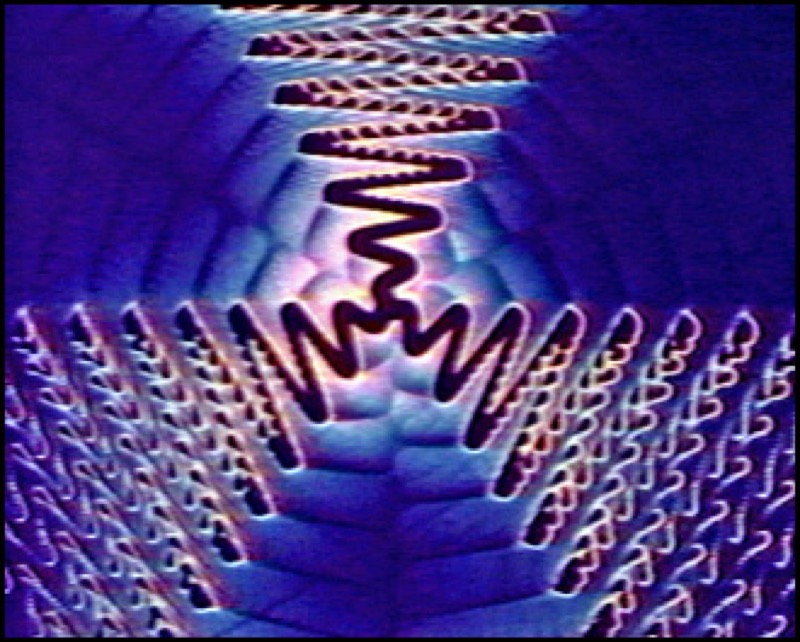
Based on the Sandin Image Processor (1973). A chain of "drawer" modules — Rutt/Etra, feedback, colorizer, shapes — and GRASS, a stage you code yourself in Metal. Also on Linux.
Discover
Based on the Quantel DPE 5000 (late 70s). Five channels with frame stores, DIGIFLIP in perspective, priority stack, Stick Box and T-bar, AUTOSEQUENCE, offline export.
Discover
Based on the Quantel Paintbox (1981). Pressure brushes, watercolor, chalk, mixing tray, lasso cut & paste — and painting over video: timeline, 8 layers, ProRes 4444 alpha export.
DiscoverThree founding dates of electronic imaging, and the software instrument that replays them today.
Dan Sandin publishes the plans for a modular analog video synthesizer, free to copy. With GRASS (Tom DeFanti, 1974), the image becomes programmable. → Sandin FX revives its drawers, in real time.
The first fully digital DVE: frame stores, perspective flips, priorities, Stick Box. It redefined TV graphics. → Q5K recreates its five channels and the T-bar.
The first broadcast paint system: pressure stylus, watercolor, lasso cut & paste. "To Paintbox" becomes a verb. → PB7 recreates it, then paints over video.
Three native applications, one shared foundation. Settings files, gestures and projects readable and copyable from one machine to another.